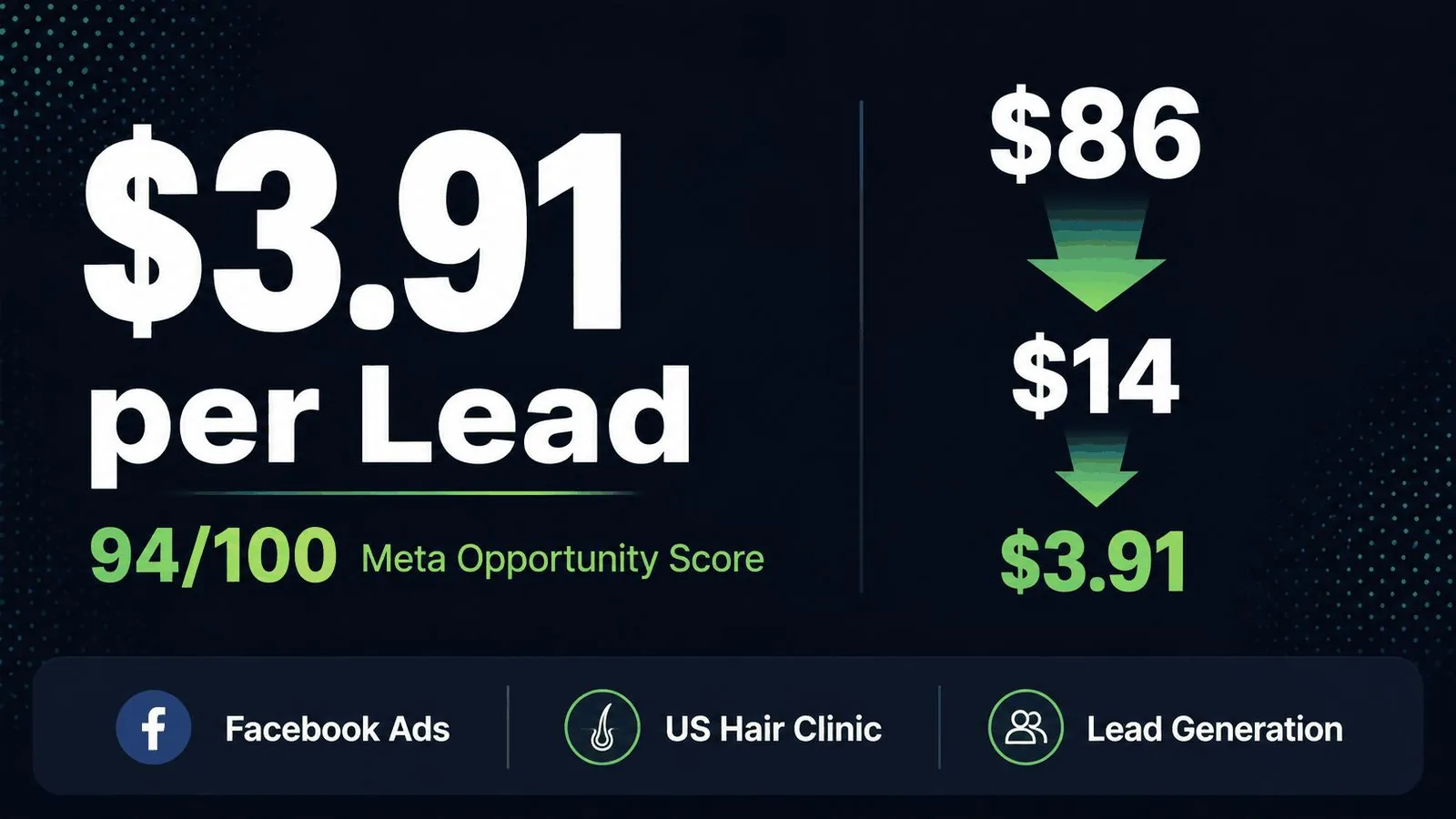
$3.91
Cost per lead (down from $86)
95%
CPL reduction
94/100
Meta Opportunity Score
35
Campaigns tested
27
Website leads on active campaign
Objective
A US-based hair clinic needed consistent, low-cost leads on a $50/day budget. They had been running ads before but the cost per lead was too high to sustain.
Strategy
- Tested 35 Facebook Ad campaigns across audiences, creatives, and placements
- Set up Facebook Pixel and Conversion API for clean attribution
- Iterated CPL down systematically from $86 to $14 to $3.91 per lead
- Scaled winning ad sets through structured optimization
Execution
The first round of campaigns gave us a baseline of $86 per lead. That was clearly too high for the budget. I reworked the audience targeting, swapped out underperforming creatives, and narrowed down placements. The second phase brought the CPL down to $14. From there, it was about finding the best-performing combinations and pushing budget toward them. The final active campaign settled at $3.91 per lead with 27 website leads and a 94/100 Meta Opportunity Score.
This figure is one row in the Facebook Ads cost per lead benchmark, alongside the other accounts it sits next to.
What the numbers show
The drop happened in two distinct steps, not gradually: $86 to roughly $14, then $14 to $3.91. The first step came from fixing measurement and narrowing the audience; the second came almost entirely from creative. That split matters, because it means the account had two separate problems and solving only one of them would have stalled at $14.
The final campaign carried a 94/100 Meta Opportunity Score with 27 website leads. On a $50/day budget, 35 campaigns is a lot of testing. The volume was necessary precisely because the budget was small. Small budgets can't buy their way out of a bad audience, so they have to test their way out.
What I'd flag
$3.91 is the cost on the winning campaign, not a blended average across all 35. Most of those campaigns cost more, and several were shut off. The honest framing is that this is what the account settled at once the winners were found, not what it averaged while finding them.
This is also a local consumer service with an emotional purchase driver, which is close to the easiest case for Meta lead generation. A B2B account selling into a small, expensive market has none of those advantages.
Want results like this?
Send me your account and I'll tell you what I'd change first. No cost, no pitch.
Get a free audit